Rust · Security Guide
Staying Undetected in Rust: A 2026 Security Guide
Getting a Rust cheat is easy; staying undetected month after month is what separates a private paid loader from a forum leak. This 2026 guide breaks down every layer that keeps a RageByte user off Facepunch's ban wave — per-user build signing, HWID spoofing integration, external Web Radar and human-tuned configs — and shows how each one addresses a specific EAC or Facepunch detection vector.
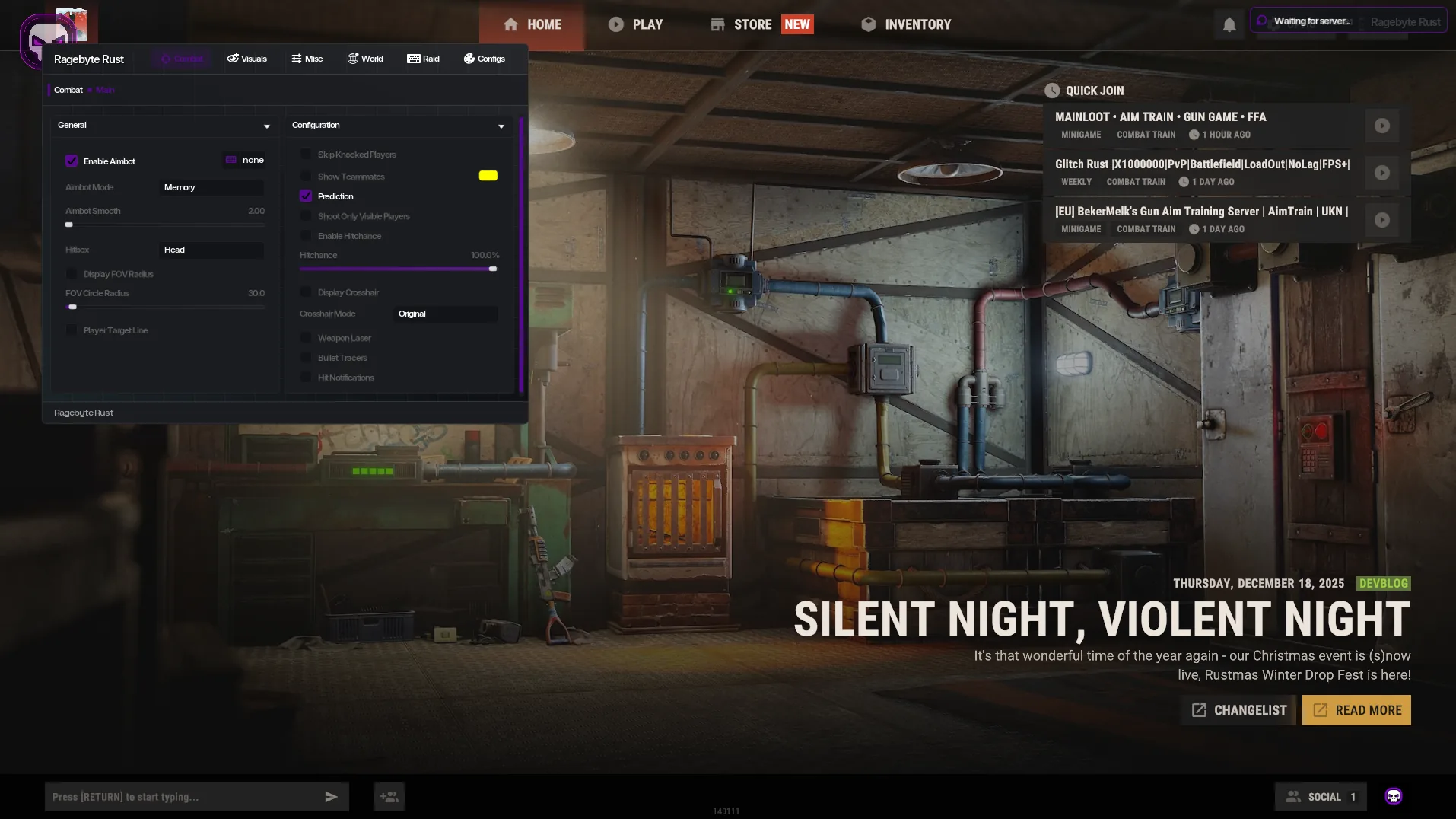
- Per-user signed builds — no two RageByte loaders share the same hash
- Wave-driven rebuilds — every EAC push triggers a fresh compile before it ships
- Integrated HWID spoofer — SMBIOS, disk, MAC, GPU and TPM reset in one flow
- Web Radar — external browser overlay that never touches Rust's memory
- Human-tuned defaults — hitchance, recoil and prediction sit below EAC's behavioural ceiling
Confirm the current product state before each session.
Eligible orders are delivered through the customer dashboard.
Review platform and hardware requirements before checkout.
Why 'undetected' is a moving target
Easy Anti-Cheat doesn't ban in real time on hash matches alone. It collects telemetry — driver enumeration, memory heuristics, mouse deltas, headshot ratios — and Facepunch batches bans in waves, usually weekly. A cheat that looked clean on Tuesday can end up on Sunday's wave. Staying undetected in Rust means two things at once: (1) your loader's binary and driver footprint never match a known cheat signature, and (2) your in-game behaviour never trips EAC's server-side heuristics. RageByte's stack is designed around both.
Layer 1 — Per-user builds and wave-driven recompiles
Every RageByte Rust download is compiled on demand and signed to your license. Two customers pulling the loader in the same hour get two different binary hashes, so a leaked signature from one user can't burn everyone else. On top of that, every EAC or Rust patch triggers an internal rebuild before status flips back to Undetected on /status — the build system rotates code layout, string obfuscation and driver mapping so the previous fingerprint is gone by the time the next wave runs. Public 'free undetected Rust cheats' can't do this; a single upload lives forever until EAC's signature list catches up, which usually takes days.
Layer 2 — HWID spoofing integration
Even a perfect loader doesn't help if EAC already knows your hardware. When Facepunch bans, EAC records SMBIOS strings, disk serials, MAC addresses, GPU device IDs and TPM identifiers. Reinstalling Windows or making a new Steam account on the same PC re-bans instantly. RageByte's Rust plan ships with the same HWID spoofer covered on /hwid-spoofer — it rotates every tracked identifier before Rust launches, so a cleaned account looks like a brand-new machine to EAC. This is the single most-skipped step in staying undetected, and it's why users who chain 'private loader + spoofer + fresh account' last months on the same hardware.
Layer 3 — Web Radar as a memory-safe alternative
The Rust Web Radar (see /rust-web-radar) is worth a section on its own because it changes the risk model entirely. It's a browser-based overlay that runs on a phone, tablet or second PC and pulls positional data through the loader's shared session, not through direct memory reads on your gaming PC. EAC has zero visibility into what's rendering in a browser on another device. For high-value accounts — long-time survivors, group leaders, streamers — running Web Radar instead of an in-game radar overlay removes one of the largest local footprints a cheat can have, at the cost of glancing at a second screen.
Layer 4 — Behavioural configs that don't trip EAC
Signature evasion doesn't matter if you rage in every fight. EAC's server-side telemetry catches obvious bots: 100% hitchance, zero recoil, perfect wall-tracking, instant snaps across 180°. The RageByte Rust default config sits deliberately below the human ceiling — hitchance around 65-80%, partial recoil left in, prediction on, silent-aim FOV kept tight. Combined with the Rust Silent Aim mode covered on /rust-silent-aim, this reads to EAC and to reviewing admins as a very good player, not a cheater. If you're chasing 'undetected' as a goal, this is the layer most users under-invest in.
How this compares to public / free Rust cheats
Free Rust cheats posted on public forums fail three of these four layers by design: one shared binary means one signature EAC eventually catches, no HWID spoofer means one ban ends the hardware, and the default configs are usually maxed out for demo videos. The 'undetected' badge on a free release typically survives 2-7 days after EAC's next signature push. RageByte's private loader stays undetected across wave after wave because the build system, spoofer and behavioural defaults are treated as one product — not a cheat glued on top of a leak. See /best-rust-cheats and /rust-anti-cheat for the deeper technical comparison.
Frequently Asked Questions
Review notes and sources
Reviewed by the RageByte product team on . This supporting page is checked against the current product page, checkout options, status information and publisher documentation. Send corrections to [email protected].
Primary reference: Facepunch Rust support. Third-party software can violate publisher rules and lead to account or hardware penalties. A status label records a current check, not a guarantee against future detection.
Before checkout, read the refund policy and privacy policy.
Explore the Rust cheat hub
Related guides on Rust EAC bypass, HWID spoofing, Web Radar and Silent Aim.
Pricing, plans and instant delivery for our private Rust build.
Silent / Memory aimbot, hitchance %, FOV and Ore Aimbot for Rust.
Memory-mode silent aim with hitchance, prediction and visible check.
Player, item, ore, radar and Raid ESP with distance and chams.
Sized, positioned 360° radar with range slider and team color.
Shareable live radar on phone, tablet or second PC — no install for teammates.
Review the current product options
Confirm compatibility, live status and purchase terms before checkout.